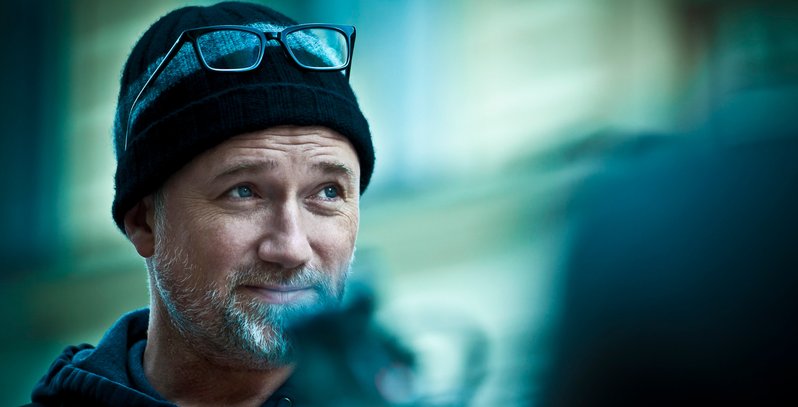
David Fincher is one of the most distinctive visual storytellers ” the director’s well-established visual style and use of film language is carried throughout the entire Season 1 arc, despite Fincher having only directed four of the ten episodes himself. IndieWire recently talked the show’s principal cinematographer Erik Messerschmidt – who was once Fincher’s gaffer, and shot 90% of “Mindhunter” – about what defines the cinematic style of the great auteur and how he built off the look of “Zodiac” to create something we aren’t use to seeing on TV.
The Color Palette
The imagery in a Fincher film is grounded in realism, but it’s a dark, stylized realism. This is most notable in the director’s use of colors. “[David] has an aversion to saturated colors and magenta,” said Messerschmidt in an interview. “The show has a desaturated green-yellow look, for sure, which is within David’s palette.”
According to the cinematographer, the color palette – which helps give the show its period feel – for “Mindhunter” comes from production designer Steve Arnold, costume designer Jennifer Starzyk and an incredibly creative locations department, not necessarily the lighting.
Framing Between the Lines
People in a room talking is not considered all that cinematic, and yet “Mindhunter,” like “Zodiac,” is filled with long interrogations, interviews, and discussions between investigators that are dominated by dialogue. As with other Fincher’s films, information is important, but not because of a need to create clarity – often it’s the opposite – or advance the plot. It’s about how the characters process this exposition and the shifts in interpersonal dynamics between characters as a result. It’s Fincher’s camera that reveals this subtext and engages the audience in the drama of what is not being said.
“The show is about the subtleties of what gets said between the lines,” said Messerschmidt. “From a cinematography standpoint the show is very much about coverage and sequencing. The scenes are long, so we are playing with shot design to build tension or accent certain pieces of information.”
The process of telling the story through the sequencing of specific compositions is bread-and-butter for Fincher (wonderfully analyzed in “Every Frame a Painting”). “Mindhunter” would fall flat relying on normal coverage. With Fincher, who wasn’t on set for six of the 10 episodes, Messerschmidt found the biggest part of his job was collaborating with the other directors on figuring out how scenes needed to be split into various shots.
“It’s very different from other television shows of this genre – it’s not just about getting the dialogue on camera in as few shots as possible,” said Messerschmidt. “We really explored covering scenes in many different ways, lots of different little setups and giving editors different options of how to share the information. Always considering when does the audience have the information, when do the characters have the information, when are they in sync, when are they not, and playing with that from a camera-lens perspective.”
 Ali Asghar's Blog